
Table of Contents

Introduction: (Best Ultra-Light but Powerful Portable Laptops 2025)
The best ultra-light but powerful portable laptops 2025 uses for travel, commute, or simply prefer a laptop that disappears into your bag, ultra-light laptops are a must. But in 2025 the story is not just about weight it’s about balancing thinness and featherweight chassis with CPUs and NPUs that can handle modern workloads: video editing, AI features on-device inference, heavy browser/tab usage, and longer battery life. The latest crop of ultra portables brings powerful processors (Apple silicon M-series and Intel Core Ultra / AMD Ryzen AI), fast storage, and improved thermals all inside chassis that often weigh under 1.4 kg (3 lbs). This guide picks the most compelling models of 2025 and tells you exactly which one fits your needs.
The Best Ultra-Light But Powerful Portables of 2025
Below are the standout machines this year, grouped by the problems they solve for this best ultra-light but powerful portable laptops 2025. I have included short spec highlights, why they matter, and who should buy this best ultra-light but powerful portable laptops 2025:
1) Apple MacBook Air (M4 Series) – The Ultra-Light All-Rounder
Why it’s here: Apple’s M-series continues to lead the thin-and-light class because Silicon integrates CPU, GPU, and Neural Engine tightly, delivering high per-watt performance and superb battery life. Reviews in 2025 crown the MacBook Air, M4 in its 13″ and 15″ flavors as the best ultra book for many users because of balanced performance, fanless or minimal-fan designs, and macOS-optimized apps.
Key specs typical build: Apple M4 (10-core variant), 8–24GB unified RAM, 256–2TB SSD, 13″ / 15″ Liquid Retina displays, battery life often in the double digits real-world 12–18+ hours depending on workload.
Why you might buy it: Exceptional battery life, smooth creative performance (photo editing, light video edits), low heat/noise, best in class trackpad and keyboard, and macOS ecosystem advantages.
Limitations: Not the best for Windows-specific apps or some niche pro software that’s Windows-native. Fewer ports (dongles often required).
2) Dell XPS 13 (2025) – Flagship Windows Ultraportable
Why it’s here: The XPS 13 has been the reference design for Windows ultraportables for years. The 2025 refresh with Intel Core Ultra (Lunar Lake / subsequent Ultra family) continued to emphasize thinness, premium materials, and competitive battery life, with reviewers praising all-day usage. For many Windows users, it’s the closest answer to a MacBook Air in the Windows world.
Key specs typical: Intel Core Ultra 5/7, integrated Intel Arc graphics, 8–32GB RAM, 256GB–2TB NVMe, 13.3″ OLED or high-res display, weight 1.1–1.2 kg.
Why you might buy it: Premium chassis, near-Mac battery life for light tasks, excellent display options, and strong Windows compatibility.
Limitations: Fewer ports, some models ship with experimental UI changes (adaptive function bars) that some users dislike. Trackpad/UX changes in 2025 models generated mixed reviews.
3) LG Gram Pro 17 (2025) – Giant Screen, Tiny Weight
Why it’s here: LG continued the “Gram” tradition delivering large displays in featherweight chassis. The 17-inch gram Pro is a favorite for users who want a big workspace without carrying a heavy 17-inch laptop. It’s a perfect fit for writers, spreadsheet power users, and creatives who prioritize screen real estate and portability together.
Key specs (typical): 17″ IPS / mini-LED options, Intel Core Ultra or Ryzen variants, up to 16–24GB RAM, large SSDs, weight usually well under what other 17″ laptops weigh (often around 1.2–1.4 kg depending on config).
Why you might buy it: Massive screen for productivity yet highly portable; great for multi-window workflows, presentations, and on-the-go creative work.
Limitations: Not the best for heavy gaming (unless configured with discrete GPU variants); battery varies by display choice and workload.
4) Slimbook Evo 14 / Evo 15 (Linux-focused, Ryzen AI) – Ultraportable For Power Users
Why it’s here: Newer ultra-thin Linux machines with AMD Ryzen AI chips have shown that niche vendors can pack serious performance into ultra-thin designs. Slimbook’s Evo series blends high refresh displays, large SSD capacity, and Ryzen AI performance and they ship with multiple Linux distributions out of the box. For users who want Linux as primary OS and raw performance in a thin chassis, these deserve consideration.
Key specs typical: AMD Ryzen AI 9 365 or similar 10 cores/20 threads, integrated Radeon 880M / RDNA 3-class iGPU, up to 128GB RAM options on certain SKUs, high-res 14–15.3″ displays, Wi-Fi 6/7 options, USB4.
Why you might buy it: Excellent for developers, data scientists, and Linux enthusiasts who need performance and portability in one package; flexible I/O and storage options.
Limitations: Driver issues for bleeding-edge components on Linux still occur; warranty/support depends on vendor; battery/power tuning varies by distro.
5) Lenovo Yoga 9i / Asus Zenbook S16 – The 2-in-1 and Design Champions
Why it’s here: Lenovo and Asus continue to offer convertible and thin premium laptops with strong displays and solid battery life. If you want a 2-in-1 or a slightly larger screen for creative tasks but still demand portability, these are excellent picks. Tom’s Hardware and other outlets list these among top ultraportables for 2025.
Key specs typical: Intel Core Ultra or Ryzen AI chips, OLED 14–16″ displays available, 8–32GB RAM, light aluminum chassis, stylus support on some models.
Why you might buy it: Flexibility (tablet mode), premium screens (OLED), and solid all-around performance in a light chassis.
Limitations: Slightly heavier than 13-inch super-light machines; price premium for OLED/touch.
How We Judged These Laptops (What Matters For Ultra-Light + Powerful)
When choosing ultra-light but capable laptops, weigh these attributes:
- Performance per watt in real-world: A processor that performs well without demanding aggressive cooling is essential Apple M and Intel Core Ultra / AMD Ryzen AI excel here. Benchmarks matter, but power efficiency is what keeps fans quiet and battery life long.
- Thermals & sustained performance: Thin chassis can throttle; look for models with good thermal headroom (vapor chambers, dual fans) or chips engineered for sustained efficiency.
- Battery life in real–world use: Vendors’ “up to” numbers vary; real tests, web browsing, video editing, office tasks are the best indicators. Many leading ultraportables now reach 10–18 hours for light tasks.
- Portability weight + footprint: Under 1.2 kg is excellent for 13–14″ machines; sub-1.4 kg for 15–17″ is impressive for that size.
- Display quality: For creators, color accuracy and brightness matter; OLED and high-res options are big pluses.
- I/O & expandability: Ultraportables tend to sacrifice ports. If you need HDMI, SD, or Ethernet often, look for models or adapters that match your workflow.
- Build & repairability: Metal chassis and user-accessible storage/RAM (rare in ultra-slim models) matter for longevity. Sustainability features, recycled materials are increasingly common.
In-Depth Buying Guide – Choose The Right Ultraportable For Your Job
The best ultra-light but powerful portable laptops 2025 is a practical decision map broken down by user type as given below:
For writers and students
- Priorities: keyboard comfort, battery, weight, price.
- Top picks: MacBook Air 13 / Dell XPS 13 / Lenovo Yoga 13.
- Why: All-day battery, comfortable typing, light weight.
For content creators (photo & light video)
- Priorities: screen size & accuracy, horsepower, storage.
- Top picks: MacBook Air 15 (M4) for macOS editing apps; LG gram Pro 17 for big screen portability; Asus Zenbook S for OLED options.
For software developers & data scientists
- Priorities: CPU cores, RAM, Linux compatibility, ports
- Top picks: Slimbook Evo (Linux preinstalled with Ryzen AI), Dell XPS configured with 32GB, Lenovo ThinkPad X1 Carbon variants for professional support.
For power users who also travel a lot
- Priorities: connectivity, battery life, light weight
- Top picks: Dell XPS 13 (all-day battery), MacBook Air 13 (M4), LG gram Pro 17 (if you want a large display without weight penalty).
For hybrid workers & creatives who present frequently
- Priorities: screen size, color accuracy, stereo speakers, webcam quality
- Top picks: MacBook Air 15, Lenovo Yoga 9i (2-in-1 flexibility), LG gram Pro 17.
Real-World Performance & Battery – What Reviewers Found
The best ultra-light but powerful portable laptops 2025, independent reviews and testing in 2025 suggest:
- Apple MacBook Air (M4) continues to lead in sustained battery life and thermals for everyday workloads, often logging 12–18 hours in light to moderate use. This makes it perfect for long travel days.
- Dell XPS 13 (2025) impressed reviewers with improved battery life and Intel’s newer chips delivering competitive performance for Windows users; it remains a top pick among premium thin-and-light Windows laptops. Some reviewers pointed out UX adjustments (function bar, trackpad changes) that are subjective.
- LG gram Pro 17 continues to be praised for delivering a 17-inch workspace at much lower weight than competitors reviewers often call it “shockingly light” for the size, making it unique in the market.
- Slimbook / Ryzen AI ultraportables show that AMD’s newer chips can push serious multi-thread workloads while maintaining good efficiency; Linux compatibility makes them strong choices for developers who want power in a light chassis.
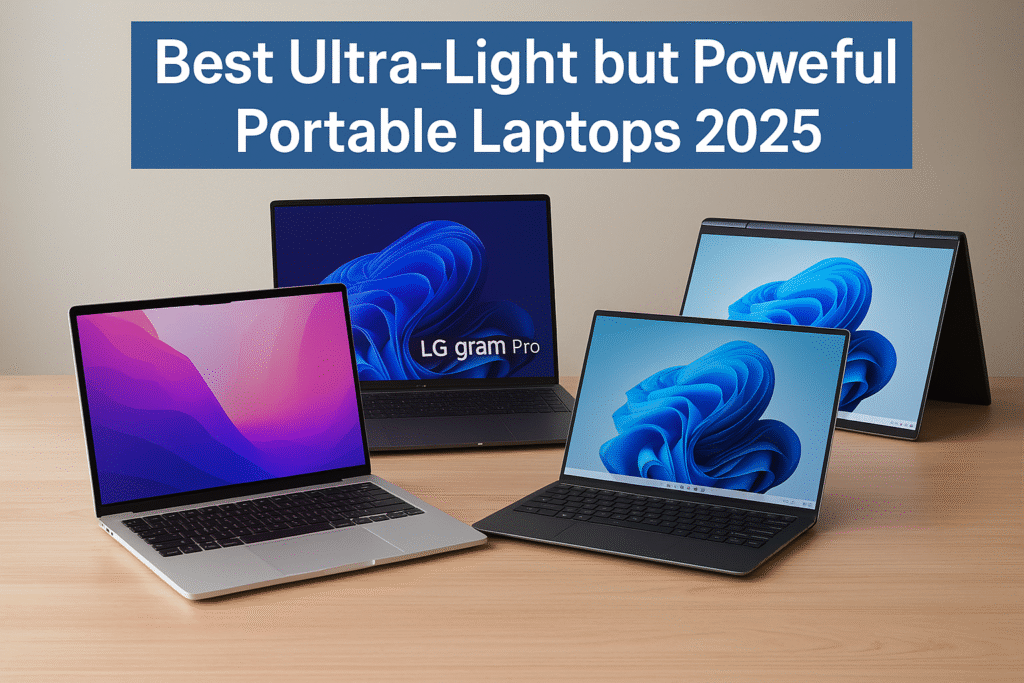
Comparison Table (At a Glance)
The best ultra-light but powerful portable laptops 2025, comparison table specifications vary by SKU:
| Model (typical SKU) | Screen | Typical Weight | CPU Options | Battery (real world) | Best for |
|---|---|---|---|---|---|
| MacBook Air (M4) | 13″/15″ Liquid Retina | 1.2 kg (13″), 1.5 kg (15″) | Apple M4 8–10 core | 12–18 hrs | Creatives, travelers. |
| Dell XPS 13 (2025) | 13.3″ OLED / FHD | 1.1–1.2 kg | Intel Core Ultra 5/7 | 10–15 hrs | Premium Windows ultraportable. |
| LG gram Pro 17 | 17″ high-res | 1.2–1.4 kg | Intel / AMD options | 7–12 hrs | Big-screen portability. |
| Slimbook Evo 14/15 | 14–15.3″ 120Hz | 1.1–1.4 kg | Ryzen AI 9 365 | 8–12 hrs | Linux devs, performance on Linux. |
| Lenovo Yoga 9i | 14–16″ OLED | 1.2–1.6 kg | Intel Core Ultra series | 8–12 hrs | 2-in-1 flexibility. |
Practical Tips to Squeeze Every Bit of Portability and Performance
Below the practical tips for the best ultra-light but powerful portable laptops 2025:
- Pick the right screen: OLED is great for contrast/color creatives, but higher brightness and refresh rates can reduce battery life. For all-day runtime, a calibrated 60–120Hz IPS with good luminance may be a better trade.
- Right RAM & storage: 16GB is the sweet spot for most users in 2025. If you do heavy video editing or VM work, move to 32GB. NVMe SSDs (PCIe 4.0 or 5.0) are a must for fast project loads.
- Thermals matter: Ultralight designs sometimes throttle under sustained heavy loads if you do long rendering sessions, choose models with better cooling solutions or consider a portable eGPU/desktop for heavy projects.
- Carry the right accessories: A compact USB-C hub with HDMI and SD card reader solves many port shortages. A compact USB-C charger (65W–100W) and a slim sleeve or backpack help protect the laptop and keep your load light.
- Check warranty & support in your country: Premium thin vendors sometimes limit on-site service regionally, if support is crucial, pick vendors with good local service networks.
Common User Scenarios & the Best Pick for Each
The common user scenarios & the best pick for each of this best ultra-light but powerful portable laptops 2025:
- Daily commuter who writes and browses: MacBook Air 13 (M4) – battery & keyboard.
- Frequent presenter who needs big screen but minimal weight: LG gram Pro 17 – large real estate without back pain.
- Developer who needs Linux & high single/multi-thread performance: Slimbook Evo with Ryzen AI – Linux preinstalled with hardware support options.
- Designer who wants color accuracy & stylus support: Lenovo Yoga 9i or Asus Zenbook S with OLED option.
- Windows user wanting premium laptop that “feels” like a MacBook: Dell XPS 13 (2025).
Pricing & Value (General Guidance)
The best ultra-light but powerful portable laptops 2025, prices are vary widely by region and spec. Generally:
- MacBook Air (M4) family: Premium pricing but strong resale and long OS support. Often excellent value for creatives who rely on macOS apps.
- Dell XPS 13 / Lenovo Yoga / Asus Zenbook: Mid-to-high range; frequent discounts make them good value when you watch deals.
- LG gram Pro 17: Premium for its niche paying for large screen + featherweight engineering.
- Slimbook / boutique vendors: Competitive pricing for high specs, but check warranty and shipping to your country.
Sustainability & Repairability (What to Look for)
The best ultra-light but powerful portable laptops 2025 are in several vendors highlight recycled materials and better end-of-life recycling. Ultraportables still lag behind larger business models in repairability due to glued batteries and soldered RAM if repairability is a priority, look for business laptop lines some ThinkPad and Latitude models or boutique vendors that offer modular designs.
Frequently Asked Questions
Generally people asks the questions regarding the best ultra-light but powerful portable laptops 2025:
Q — What counts as an “ultra-light” laptop in 2025?
A — For 13–14″ machines, ultra-light usually means 1.2 kg (2.6–2.8 lbs) or less. For 15–17″ models, anything under 1.4 kg is exceptionally light and rare. LG’s gram 17 is a leading example of a large laptop in a very light package.
Q — Are ultra-light laptops fast enough for video editing?
A — Yes for light to moderate edits (short 1080p/4K projects) especially Apple M4 and higher-end Intel/AMD SKUs. For long, heavy renders, a thicker chassis with stronger cooling or a desktop may be better.
Q — Is MacBook Air better than Dell XPS for portability?
A — Both are great; MacBook Air tends to win on battery life and thermals for many workflows due to Apple Silicon. Dell XPS is the best Windows alternative with premium build and strong battery life. Choose based on OS and app needs.
Q — Which ultraportable has the best display in 2025?
A — OLED panels in Asus Zenbook S, some Lenovo Yoga and high-end XPS SKUs are excellent. Apple’s Liquid Retina displays are also top tier for color and brightness. Compare color calibration metrics if color accuracy is crucial.
Conclusion
The best ultra-light but powerful portable laptops 2025 proves that portability no longer means sacrificing power. Today’s ultra-light laptops combine next-generation processors, efficient NPUs, and premium displays in bodies that often weigh less than a kilogram and still deliver all-day battery life. Whether you choose the MacBook Air M4 for unmatched endurance, the Dell XPS 13 for a premium Windows experience, the LG gram Pro 17 for a big screen with featherweight design, or Linux-ready options like the Slimbook Evo for open-source flexibility, every category of user can now enjoy top-tier performance in a travel-friendly package. Prioritize the combination of performance per watt, thermals, battery, and display to pick the right one for your daily work.
Before buying, focus on what matters most to your workflow performance per watt, display quality, battery life, and port selection. The best ultra-light laptop is the one that keeps up with your daily tasks while staying light enough to carry everywhere. With the right pick, you can work, create, and play without compromise, proving that 2025 is the year when true mobility and serious power finally meet.
