
Table of Contents

Introduction: Best On-Device AI vs Cloud AI in Laptops 2026
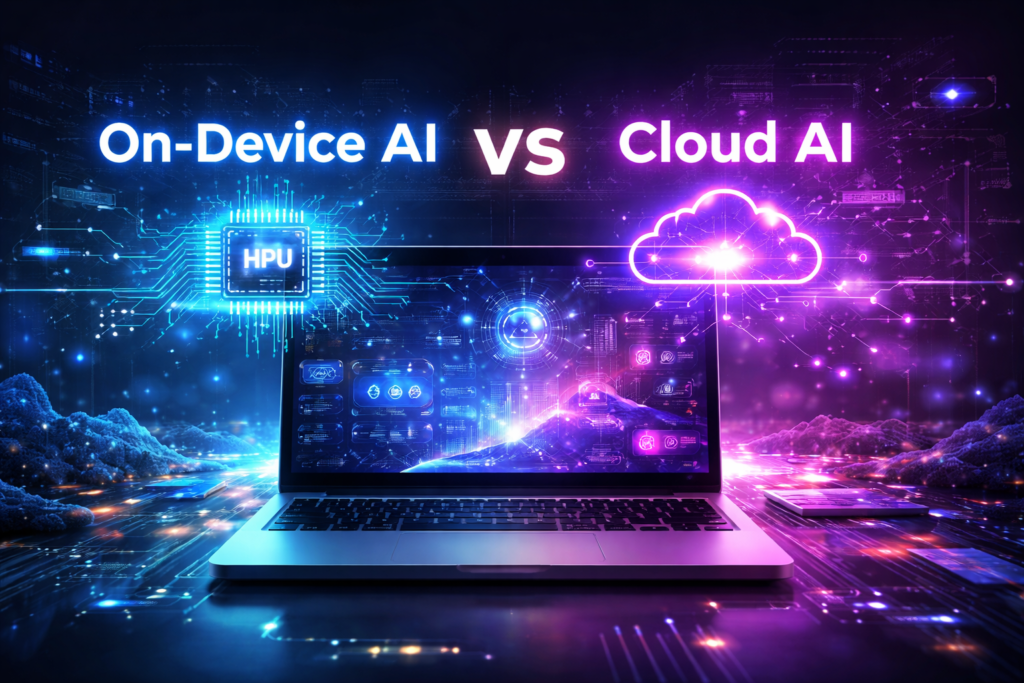
The best On-Device AI vs cloud AI in laptops 2026, artificial intelligence is transforming the modern computing landscape faster than any technological innovation of the past decade. In 2026, laptops are no longer just productivity machines; they have evolved into intelligent devices capable of performing complex AI tasks such as voice recognition, image processing, real-time translation, automated writing assistance, and predictive analytics. At the center of this transformation lies a major architectural debate: On-Device AI vs Cloud AI in laptops.
Many modern AI laptops now include specialized hardware like Neural Processing Units (NPUs) that allow AI tasks to run directly on the device rather than relying entirely on remote servers. These dedicated AI processors can perform tens of trillions of operations per second and enable advanced features such as real-time translation, intelligent search, and image generation locally on the best On-Device AI vs cloud AI in laptops 2026.
However, cloud-based AI still dominates many applications because it offers access to massive computing resources, large AI models, and real-time collaboration capabilities that local hardware cannot always match.
This technological shift has led to a key question for users, developers, and businesses:
Which approach is better for laptops in 2026: On-Device AI or Cloud AI?
The answer is not as simple as choosing one over the other. Both technologies have strengths and limitations. In many cases, modern AI laptops use a hybrid approach, combining local processing with cloud intelligence to deliver faster performance and better privacy while maintaining access to powerful AI models.
In this comprehensive guide, we will explore everything you need to know about best On-Device AI vs cloud AI in laptops 2026, including:
- What On-Device AI is
- What Cloud AI is
- How AI laptops work
- Key differences between local AI and cloud AI
- Benefits and limitations of both technologies
- Real-world laptop applications
- The role of NPUs and AI processors
- Which approach is better for different users
- The future of AI-powered laptops
By the end of this article, you will understand how AI processing is evolving and which approach delivers the best performance, privacy, and efficiency for modern laptops.
Understanding AI in Modern Laptops
The Rise of AI PCs
The concept of AI PCs or AI laptops has rapidly gained popularity since 2024. These devices include specialized hardware designed specifically for artificial intelligence workloads.
Unlike traditional laptops that rely only on CPUs and GPUs, modern AI laptops integrate three main computing components:
- CPU (Central Processing Unit) – Handles general computing tasks
- GPU (Graphics Processing Unit) – Manages graphics and parallel computing
- NPU (Neural Processing Unit) – Dedicated processor for AI tasks
NPUs are optimized to run machine learning algorithms efficiently while consuming minimal power. They also reduce the workload on CPUs and GPUs, improving overall system performance and battery life.
This architecture allows laptops to perform AI tasks such as:
- Real-time speech recognition
- Image enhancement
- Intelligent search
- Background noise removal
- AI-powered productivity tools
- Smart system optimization
The development of AI PCs is one of the biggest changes in personal computing since the transition from desktops to mobile laptops.
What is On-Device AI in Laptops?
Definition
The best On-Device AI vs cloud AI in laptops 2026 refers to artificial intelligence processing that runs directly on a laptop’s hardware without requiring an internet connection or external servers.
In this approach, AI models are stored and executed locally using the laptop’s CPU, GPU, or NPU.
Instead of sending data to cloud servers for analysis, the laptop processes everything internally.
How On-Device AI Works
When AI tasks run locally, the process typically involves the following steps:
- User inputs data (voice, text, image, etc.)
- The laptop’s AI processor analyzes the data
- The AI model generates results instantly
- The output appears on the device
Because the processing happens locally, the system avoids network delays and can deliver nearly instant responses.
Examples of On-Device AI Features
Modern laptops with AI processors can perform many tasks locally, including:
1. Real-Time Voice Recognition
Speech-to-text systems can convert spoken language into text instantly.
2. AI-Powered Image Editing
Local AI can remove backgrounds, enhance photos, and detect objects in images.
3. Live Translation
AI laptops can translate conversations in real time without internet access.
4. Smart Video Effects
Features like background blur, eye contact correction, and lighting adjustments can run locally.
5. Intelligent Search
Users can search their files using natural language queries.
Key Advantages of On-Device AI
Faster Response Time
Because there is no need to send data to remote servers, on-device AI delivers extremely low latency and faster results.
Better Privacy
Sensitive data remains on the user’s device, reducing the risk of data leaks or misuse.
Offline Functionality
On-device AI can work even without internet access, making it useful in remote locations or during travel.
Improved Security
Since data never leaves the device, it is less vulnerable to cyber threats.
Reduced Cloud Costs
Running AI locally avoids recurring cloud computing expenses.
What is Cloud AI in Laptops?
Definition
Cloud AI refers to artificial intelligence processing that occurs on remote servers rather than on the user’s laptop.
In this approach, the laptop sends data to powerful cloud data centers where AI models process the information and return results.
How Cloud AI Works
The process typically follows these steps:
- User inputs data on the laptop
- Data is sent to cloud servers via the internet
- AI models process the request
- Results are returned to the laptop
This method allows users to access extremely powerful AI models without requiring expensive hardware on their devices of best On-Device AI vs cloud AI in laptops 2026.
Examples of Cloud AI in Laptops
Cloud AI powers many widely used applications, including:
- AI chat assistants
- Large language models
- Cloud-based image generation
- AI coding assistants
- Online productivity tools
- Smart search engines
These systems rely on massive GPU clusters and large datasets that cannot be stored locally.
Advantages of Cloud AI
Access to Large AI Models
Cloud servers can run models with billions or trillions of parameters, far beyond what a laptop can handle.
Continuous Learning
Cloud AI systems constantly update and improve using global data.
Unlimited Scalability
Cloud infrastructure can handle huge workloads.
Cross-Device Integration
Users can access the same AI features across phones, laptops, and tablets.
On-Device AI vs Cloud AI: Key Differences
Processing Location
On-device AI runs locally on laptop hardware, while cloud AI runs on remote servers.
Speed
On-device AI usually delivers faster responses because it eliminates network delays.
Cloud AI can be slower due to internet latency and server queues.
Privacy
On-device AI keeps data on the device, providing better privacy protection.
Cloud AI requires sending data to external servers, which raises privacy concerns.
Performance
Cloud AI offers far greater computing power and can run extremely large models.
On-device AI is limited by hardware capabilities and battery constraints.
Internet Dependency
On-device AI works offline.
Cloud AI requires a stable internet connection.
Role of Neural Processing Units (NPUs)
The key technology enabling on-device AI in laptops is the Neural Processing Unit (NPU).
NPUs are designed specifically to accelerate machine learning tasks while consuming less power.
They can perform AI computations much more efficiently than CPUs or GPUs.
Key benefits include:
- Faster AI processing
- Lower power consumption
- Reduced system workload
- Improved battery life
These processors allow the best On-Device AI vs cloud AI in laptops 2026 to perform advanced AI tasks such as object detection, voice recognition, and predictive analytics locally.
Real-World Applications of On-Device AI in Laptops
AI-Powered Productivity Tools
Modern laptops use AI to summarize documents, generate writing suggestions, and organize information automatically.
Smart Video Conferencing
AI can enhance video calls by removing background noise, adjusting lighting, and improving camera framing.
AI Image Processing
On-device AI enables instant image editing, object removal, and photo enhancement.
AI Coding Assistants
Developers can run lightweight coding models locally for code suggestions and debugging.
Real-World Applications of Cloud AI in Laptops
Large Language Models
Advanced chatbots and generative AI tools rely heavily on cloud computing.
AI Content Generation
Tools for writing, image generation, and video creation often require large cloud-based models.
Data Analysis
Businesses use cloud AI to analyze large datasets and generate insights.
Collaboration Tools
Cloud AI enables shared editing, predictive analytics, and team collaboration features.
Hybrid AI: The Future of AI Laptops
Most experts believe the future of AI computing will combine both approaches.
This model is known as Hybrid AI.
In a hybrid system:
- Simple AI tasks run locally
- Complex tasks run in the cloud
For example:
Local AI may handle voice commands and image enhancement.
Cloud AI may process complex queries or generate large documents.
This combination offers the best balance between speed, privacy, and computational power.
Advantages of On-Device AI in Laptops
Privacy Protection
Local processing prevents sensitive data from being transmitted online.
Faster User Experience
Tasks such as voice commands and image recognition feel instant.
Offline Functionality
Users can access AI tools even without internet connectivity.
Energy Efficiency
NPUs perform AI tasks using less power than traditional processors.
Limitations of On-Device AI
Despite its benefits, on-device AI still has limitations.
These include:
- Limited computing power
- Smaller AI models
- Memory constraints
- Thermal limitations
Large AI models still require cloud processing.
Advantages of Cloud AI
Cloud AI remains powerful because it offers:
- Access to massive computing clusters
- Continuous updates
- Large context models
- Cross-platform integration
Limitations of Cloud AI
Cloud AI also has drawbacks:
- Internet dependency
- Higher latency
- Privacy concerns
- Ongoing usage costs
Which AI Approach is Best for Laptop Users?
The best On-Device AI vs cloud AI in laptops 2026 choice depends on how you use your laptop.
Best for Privacy
On-device AI
Best for Performance
Cloud AI
Best for Offline Work
On-device AI
Best for Advanced AI Models
Cloud AI
The Future of AI Laptops (2026–2030)
AI computing is expected to evolve rapidly over the next few years.
Future developments may include:
- More powerful NPUs
- Local AI assistants
- Hybrid cloud-device AI models
- Personalized AI systems
- AI-optimized operating systems
By 2030, most laptops will likely run AI workloads both locally and in the cloud.
Conclusion
The debate between best On-Device AI vs cloud AI in laptops 2026 is not about choosing one technology over the other. Instead, it is about understanding how both approaches work together to deliver the best computing experience.
On-device AI provides faster responses, improved privacy, and offline functionality, making it ideal for everyday AI tasks such as voice recognition, image processing, and intelligent system features.
Cloud AI, on the other hand, offers massive computational power and access to large AI models capable of performing advanced tasks such as content generation, large-scale data analysis, and deep learning applications.
In 2026, the most advanced laptops combine both technologies through hybrid AI systems. Local AI processors handle immediate tasks while cloud infrastructure manages complex workloads.
This hybrid model represents the future of intelligent computing, where laptops become powerful AI companions capable of understanding user behavior, optimizing productivity, and delivering smarter digital experiences to the best On-Device AI vs cloud AI in laptops 2026.
As AI hardware continues to improve and software ecosystems evolve, the next generation of laptops will redefine how people work, create, and interact with technology.