
Table of Contents

Introduction: Best OLED vs IPS Laptop Display in 2026
The best OLED vs IPS laptop display in 2026 has become more important than ever. With rapid advancements in display technology, users are no longer limited to basic LCD panels. Instead, the debate has shifted toward OLED vs IPS laptop displays, two of the most popular and widely used screen technologies today.
Whether you are a gamer, content creator, student, or office professional, the display directly impacts your experience. From color accuracy and brightness to battery life and eye comfort, your choice of display determines how enjoyable and productive your laptop usage will be.
In this comprehensive guide, we will explore:
- What OLED and IPS displays are
- Key differences between them
- Pros and cons of each
- Real-world usage comparisons
- Which display is best for gaming, office work, and content creation
- Future trends in laptop displays (2026 and beyond)
By the end of this article, you will have a crystal-clear understanding of which display suits your needs through the best OLED vs IPS laptop display in 2026.
What is an OLED Laptop Display?
OLED stands for Organic Light-Emitting Diode. Unlike traditional displays, OLED panels do not require a backlight. Instead, each pixel emits its own light independently.
This fundamental difference gives OLED displays a significant advantage in visual quality.
Key Characteristics of OLED Displays
- Self-emissive pixels (no backlight required)
- True blacks (pixels turn completely off)
- Infinite contrast ratio
- Ultra-fast response time (<1ms)
- Extremely vibrant colors
OLED panels deliver cinematic visuals, making them ideal for entertainment and creative work.
What is an IPS Laptop Display?
IPS stands for In-Plane Switching, a type of LCD (Liquid Crystal Display) technology. Unlike OLED, IPS panels rely on a backlight to illuminate pixels.
Key Characteristics of IPS Displays
- LED backlighting system
- Excellent color accuracy
- High brightness levels
- Wide viewing angles
- No burn-in risk
IPS displays are known for their consistency and reliability, making them popular for office work and general use.
OLED vs IPS: Core Technology Difference
The fundamental difference lies in how they produce light:
| Feature | OLED | IPS |
|---|---|---|
| Light Source | Self-emitting pixels | Backlight (LED) |
| Black Levels | True black (pixel off) | Dark gray |
| Contrast | Infinite | Limited |
| Power Consumption | Content-dependent | Constant |
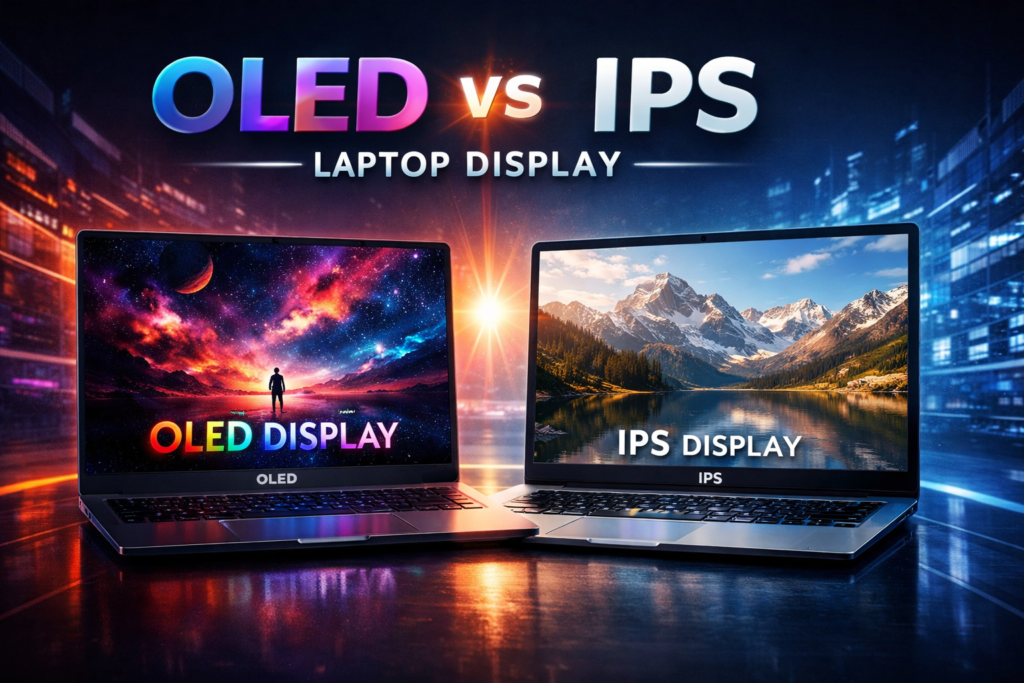
OLED pixels can turn off individually, resulting in perfect blacks and no light bleed, while IPS screens always have some backlight glow.
OLED vs IPS: Detailed Feature Comparison
1. Picture Quality & Contrast
The best OLED vs IPS laptop display in 2026 displays dominate here.
- True black levels
- Infinite contrast ratio
- No halo effect
IPS displays, even with improvements, still show grayish blacks due to backlighting.
👉 Winner: OLED
2. Color Accuracy & Vibrancy
- OLED: More vibrant, saturated colors
- IPS: More natural and consistent colors
OLED is better for media consumption, while IPS is ideal for professional color work.
👉 Winner: Tie (depends on usage)
3. Brightness
IPS displays generally achieve higher brightness levels, making them better in outdoor or bright environments.
👉 Winner: IPS
4. Viewing Angles
Both offer wide viewing angles, but OLED maintains perfect consistency from all angles.
👉 Winner: OLED
5. Response Time & Motion Handling
OLED panels have near-instant response times, making them ideal for gaming.
👉 Winner: OLED
6. Battery Life
- OLED consumes less power in dark mode
- IPS consumes consistent power regardless of content
👉 Winner: Depends on usage
7. Burn-in Risk
OLED has a potential risk of burn-in when static images remain for long periods.
IPS has zero burn-in risk.
👉 Winner: IPS
8. Eye Comfort
- OLED: Better for dark environments
- IPS: Better for long working hours
OLED vs IPS: Pros and Cons
OLED Display Pros
- Stunning visuals and contrast
- Perfect blacks
- Ultra-fast response time
- Better HDR performance
OLED Display Cons
- Burn-in risk
- Expensive
- Lower brightness in some cases
- Potential color oversaturation
IPS Display Pros
- Reliable and durable
- No burn-in issues
- High brightness
- Accurate colors
- More affordable
IPS Display Cons
- Lower contrast
- Backlight bleed
- Slower response time
Best Use Cases: OLED vs IPS in 2026
1. Gaming
OLED is superior due to:
- Faster response time
- Better motion clarity
- Deeper blacks
👉 Best Choice: OLED
2. Content Creation
- OLED: Better for video editing
- IPS: Better for photo editing (accuracy)
👉 Best Choice: Depends on workflow
3. Office Work & Productivity
IPS is better because:
- No burn-in risk
- Better for static content
👉 Best Choice: IPS
4. Watching Movies & Streaming
OLED provides a cinematic experience with:
- Deep blacks
- High contrast
👉 Best Choice: OLED
5. Outdoor Usage
IPS wins due to higher brightness.
👉 Best Choice: IPS
OLED vs IPS: Real-World Performance
In real-world usage:
- OLED feels premium and visually stunning
- IPS feels practical and reliable
Many users report that once they switch to OLED, it’s hard to go back due to superior visuals.
However, professionals still prefer IPS for long-term usage stability.
Latest Trends in 2026 Laptop Displays
1. Rise of OLED Laptops
Premium laptops increasingly feature OLED displays, offering better visuals and HDR performance.
2. Hybrid Technologies
Technologies like:
- Mini-LED IPS
- QD-OLED
are bridging the gap between OLED and IPS.
3. Higher Refresh Rates
OLED laptops now support:
- 120Hz to 240Hz refresh rates
- Ultra-smooth gaming experience
OLED vs IPS Price Comparison
These are the comparison between the best OLED vs IPS laptop display in 2026:
| Category | OLED Laptop | IPS Laptop |
|---|---|---|
| Budget | Rare | Common |
| Mid-range | Limited | Widely available |
| Premium | Dominant | Available |
OLED laptops are generally more expensive but offer better visuals.
OLED vs IPS: Which Should You Choose?
Choose OLED if:
- You love watching movies
- You play games
- You want premium visuals
- You do creative work
Choose IPS if:
- You work long hours
- You use static apps (Excel, coding)
- You need durability
- You want a budget-friendly option
Expert Verdict 2026
- Best Overall Experience: OLED
- Best Practical Choice: IPS
OLED is the future of display technology, but IPS remains relevant due to its reliability and affordability.
Frequently Asked Questions (FAQs)
People generally ask the questions regarding the best OLED vs IPS laptop display in 2026:
Is OLED better than IPS for laptops?
Yes, for visuals and gaming. No, for durability and long-term productivity.
Does OLED burn-in still happen in 2026?
Yes, but it’s less common due to improved technology.
Which display is best for students?
IPS is better due to affordability and durability.
Is OLED worth the extra cost?
If you value visuals, absolutely yes.
Conclusion
In 2026, the battle between OLED and IPS laptop displays is no longer about which is better overall it’s about which is better for you.
OLED represents the future with its stunning visuals, infinite contrast, and lightning-fast response times, making it the perfect choice for gamers, creatives, and entertainment lovers.
On the other hand, IPS continues to dominate in practicality, reliability, and affordability, making it ideal for students, professionals, and long-hour users.
Ultimately, your decision should depend on your usage:
- Choose OLED for experience
- Choose IPS for practicality
As display technology continues to evolve, we may soon see hybrid solutions that combine the best of both worlds. But for now, understanding your needs is the key to making the right choice to the best OLED vs IPS laptop display in 2026.